
Ecstasy and Irony
"Two contradictory impulses meet in poetry..."

[drawing LS2024]
“Two contradictory impulses meet in poetry: ecstasy and irony.” Adam Zagajewski
-from, Two Cities: On Exile, History and the Imagination.
Her sister is in a safe room in Tehran. His mother is in a safe room in Tel Aviv. There are dead schoolgirls in Minab, their desks overturned. Nothing beautiful about these sentences. Nothing ecstatic about these images. The brother and the mother are in separate countries, countries now at war. The siblings are united by concern for the safety of their families. The Iranian schoolgirls will not grow up to make art, write novels, give birth.
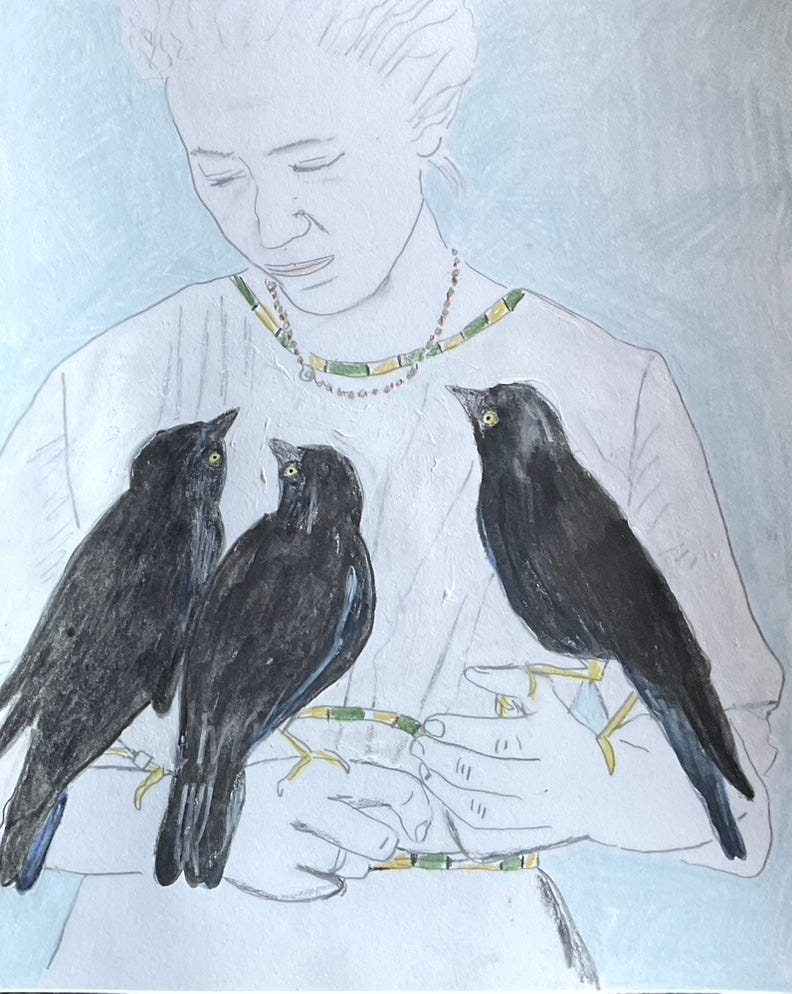
The Kurdish woman in the Bielowieza Forest on the border with Poland and Belarus gave birth alone. She died and fellow marooned migrants buried her and her baby. During the Holocaust, many Jews hid in the Bielowieza Forest. Mighty European bison roam the forest, and feral pigs, foxes, and lynx. A Polish naturalist named Simona Kossak lived in the Bielowieza forest in a wooden hut with no electricity for thirty years, her companions a wild boar, several jackdaws, and a lynx. Here comes the ecstasy. The smell of moss in the swamps, a mighty bison disappearing into the shadows of old growth trees. “Ecstasy is being able to accept the entire world. Irony knows the world is tragic and sad,” wrote Zagajewski. I’m not sure what the difference is; though irony questions everything, has doubts, even about poetry. The ecstatic naturalist in the Bielowieza Forest, conversing with her jackdaws. The tragedy of a child in Tehran whose school has been bombed by the US. The Kurdish woman dying of hypothermia in the Bielowieza Forest, a dead infant under a pile of leaves. Hunted people, protected animals. Irony. Storks build their nests on chimneys. The only animal that speaks in the Bible, other than the serpent, is a donkey, God allows the donkey to speak after Balaam beat it three times for stopping to avoid an angel with a sword, saving Balaam’s life. “What have I done unto thee, that thou hast smitten me these three times?” Balaam didn’t see the angel with the sword. Irony. He doubted the donkey, and thus he doubted poetry as well.
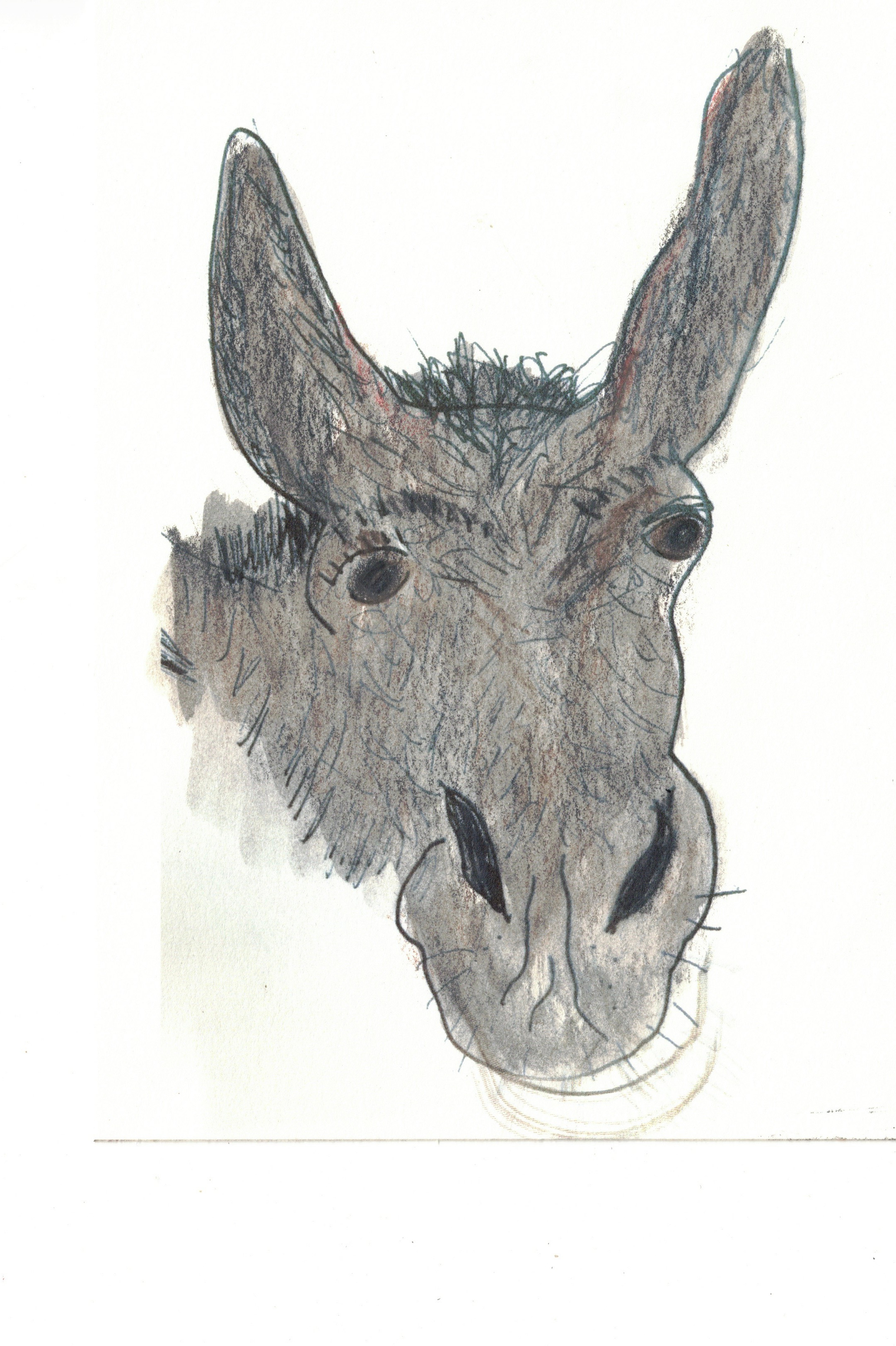
I fell in love with a donkey last spring, in a pasture in the Sierra foothills. His rough coat was dark brown; his eyes like infinite pools of empathy. When he heard me calling, he galloped across the pasture braying. My heart began pounding. I felt attuned to Titania queen of the fairies in A Midsummer Night’s Dream, bewitched by Oberon into falling in love with an ass. I suddenly understood; entirely possible.
Which is why last week, I finally visited a donkey sanctuary. In addition to stroking donkeys, scratching their long ears and looking into their patient knowing liquid eyes, I learned many things, like, you can ride a horse off a cliff, but never a donkey. The donkey is surefooted and takes care of itself. The donkey wants to know where it’s going. It thinks before it acts. It takes its time. It decides for itself. That donkey that I fell in love with in the pasture a year ago lived alone; and donkeys should never live alone. Maybe that’s why his braying was so emotional. Donkeys bond to other donkeys and at the sanctuary, when a donkey dies, they close down the whole ranch so that all the donkeys can mourn. They need to see the body, smell the body. The donkey funereal orchestra tunes up its symphony of grief in many octaves. I also learned that donkeys are threatened, there’s an international trade in donkey hides and a gel made from their hooves is used in Chinese medicine. I tried to watch the fine films Eo and Au Hasard Balthazar and I couldn’t bear to see a donkey in extremis. I am glad to know that donkeys are not friendless. There are kind people around the world who rescue them from kill pits (where they’re sold by the pound), take them in, feed them, nurse their wounds from stabbings, blindings, beatings and worse.
No one can enter the forbidden zone on the border between Belarus and Poland. No journalists are allowed to witness the human suffering there. The far right spreads lies about the danger of non-white migrants, just like here. there are masked border guards armed with 9-millimetre Glock handguns, bulletproof vests, handcuffs, and pepper spray. thermal imaging and night vision goggles to detect people on the move. There is barbed wire. Just like here. There are people sleeping on the ground in the cold. There are people who beat animals and let pregnant women die in the cold, drop bombs on schoolgirls. There are kind people who speak to jackdaws and rescue donkeys and offer refugees a warm place to rest. Irony knows the world is tragic and sad. We woke up to another war this morning. Ecstasy is ready to accept everything, unconditionally. The impulses meet in poetry, Adam Zagajewski reminds us, concluding, with no small amount of irony: that it’s “no wonder almost no one reads poems.” But Adam also reminds us to “try to praise the mutilated world.” We have to try. that’s poetry.
LSdrawing2024
We share the same love for donkeys, the same questions about wars. 🌷🌹
Thank you, Louise, for your thoughtfulness, your articulateness, and your giant heart.